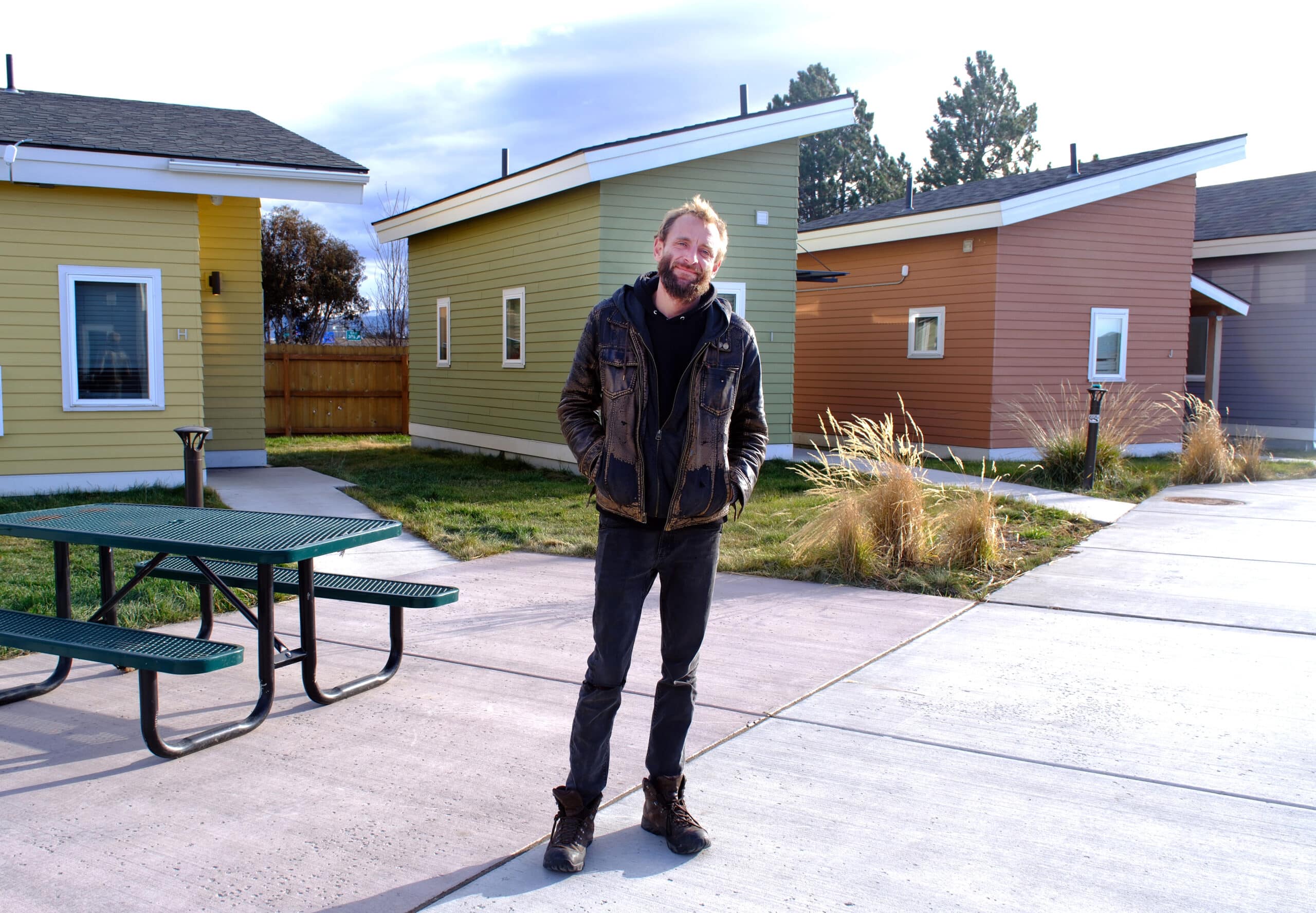
The Human Resource Development Council (HRDC) IX’s Housing First Village provides housing and supportive services for people in Bozeman who are chronically homeless and frequent users of emergency services. The cluster of 19 colorful tiny homes, on-site services, and the community they provide help residents manage their health conditions and improve their well-being.
Permanent supportive housing provides people who are chronically homeless and have complex medical needs with housing and supportive services like case management, health care, recovery support, and employment assistance. The goals of this intervention are to improve people’s health outcomes and reduce their reliance on costly community emergency systems, like the ER and law enforcement.
In 2018, the Montana Healthcare Foundation (MTHF) launched the Housing is Health Care Initiative to help communities plan for and develop permanent supportive housing. To date, grantee communities have developed 89 permanent supportive housing units across the state, with an additional 35 currently in development.
These developments are making a difference by providing people with stability and support, and by reducing reliance on local emergency services. For example, one community reported a 90% reduction in ER visits, a 70% reduction in inpatient hospital stays, and a 63% reduction in jail stays. Sites also report low eviction rates, with only one eviction across all units in the past year.
Developing and sustaining permanent supportive housing can be challenging because it requires community collaboration, housing development, and partnerships with organizations that provide a range of needed on-site support services. HRDC’s Housing First Village in Bozeman provides a good example of how one community with strong leadership developed permanent supportive housing and is making an impact on its residents.
The Housing First Village
HRDC is a community action agency that leads local interventions to combat homelessness, including managing Bozeman’s emergency shelters, transitional housing, and affordable apartments for individuals and families.
In 2016, HRDC began examining the costs of chronic homelessness to the community. In many communities, there is a small subset of people who are chronically homeless and struggle with mental illness, substance use disorders, and chronic health conditions. These co-occurring issues result in frequent ER visits and interactions with law enforcement, which are costly in terms of money, time, and community resources.
In 2018, HRDC joined the MTHF’s Housing is Health Care Initiative. With support from the foundation and technical assistance from the Corporation for Supportive Housing, HRDC began bringing together community partners to understand the community’s resources and gaps, and collaboratively identify the need for supportive housing.
“I love solving hard problems, and chronic homelessness is a really hard problem. We have to help communities understand that homelessness is not free. They are paying costs such as corrections and emergency response anyway, so working hard to figure out a better way to help improve lives and health outcomes for these vulnerable people while reducing costs and service provider loads just makes sense.”
Tracy Menuez, MTHF Senior Program Officer and former HRDC Community Development Director
HRDC outlined their process for developing the Housing First Village in detail in the “Housing First Village Guidebook,” a resource for other communities interested in pursuing similar projects.
The Housing First Village opened its doors in November 2021, creating a low-barrier neighborhood centered around dignity and community. Now that it has been operating for nearly five years, we can see how people’s lives are being improved and what is possible when a community collaborates to address chronic homelessness.
Community Impact
Greg Overman spent 15 years teaching high school before joining HRDC as the supportive housing manager. He can be credited with much of the work of building community in the Housing First Village and helping residents learn self-care, conflict resolution, and how to be good neighbors. The Housing First Village is an open campus where residents are not required to use support services or maintain sobriety. Greg said he is overwhelmed with excitement at seeing his residents voluntarily reach out for services and support.
“I feel really honored to watch people improve. The tenacity and resilience of individuals are mind-blowing and housing is what does it. Building community among residents is as important as delivery supportive services. It helps breed accountability among neighbors and shared responsibility for each other which, in turn, promotes safety and security.”
Greg Overman, HRDC Supportive Housing Manager
Curating the appropriate services and making them available to residents on-site as well as financially sustainable are among the most challenging aspects of the permanent supportive housing model. HRDC met this challenge by bringing together multiple community partners. In addition to having access to case management provided by HRDC, residents can also voluntarily access behavioral health counseling, provided by One Health, the local Federally Qualified Health Center; nursing provided by public health nurses at the Gallatin City-County Health Department; and psychiatry, counseling, and medication management provided by L’Esprit through its Program for Assertive Community Treatment Team.
Since the Housing First Village opened, the Bozeman Health ER now sees some patients less frequently and has more confidence that they are getting the follow-up care they need.
“It feels safer now to be able to discharge someone to a home and not just to the ED waiting room or the street. To have a place to store medications and rest safely makes all the difference for their health.”
Eric Lowe, MD, Bozeman Health Emergency Department Medical Director
Since moving into Housing First Village, Corinne has worked diligently on her recovery. After growing up in foster care and becoming homeless and reliant on substances at a young age, the stability of a home and the available supportive services have allowed her to build a life and gain full custody of her young daughter. She decorated her home with artwork and photos and painted her daughter’s bedroom pink. In addition to being a mom, Corinne volunteers at HRDC’s Warming Center, doing laundry and helping to keep the facility clean.
“Without this house, I wouldn’t have a chance. I have come further than I thought, and I have a house to call my own. It’s the simple things like having dishes I can wash and have somewhere to put them away.Corinne, Housing First Village resident


Sharome spent 30 years chronically homeless, with disabling mental health challenges, before moving into Housing First Village as one of its first residents. She still struggles to believe she has a place to call her own and worries that someone will one day come to take it away from her, even though she receives repeated reassurance that permanent supportive housing has no residency time limit.
“They gave me a brand-new house and handed me the keys. They even had a cake to welcome me. A house is almost as important as having a best friend. My home protects me, and I have even started to pay rent.”
Sharome, Housing First Village resident

Sara Savage, former case manager and chief operations officer at HRDC, believes that people’s lives are being lengthened through permanent supportive housing. She said that watching clients being discharged from inpatient behavioral health stays into a home and knowing that supportive services were there to supervise medication administration and counseling visits was an enormous relief.
“I have seen residents become physically transformed. Their eye contact is better, and they have gained a sense of purpose and pride. One of my first case management clients is an original Housing First Village resident, and I am amazed that she is still there, given how many barriers were working against her. When I see her now, the pride on her face is something I get to carry with me forever.”
Sara Savage, former HRDC Chief Operations Officer and Case Manager
Credits: Interviews and writing contribution by Buck Taylor, MPH, BMT Consulting, LLC, Principal Consultant. Photos were taken by Janie Osborne.